

Tantalum, as a core and critical material in the fields of electronics, aerospace, and new materials, has its purity directly determine the stability, corrosion resistance, and service life of components. Trace impurities can significantly degrade the performance and quality of tantalum materials; therefore, accurate detection of impurity elements is a core and critical step in the production and quality control of tantalum products.

AES-8000 AC/DC ARC EMISSION SPECTROMETER
Among numerous detection techniques, arc atomic emission spectrometry possesses advantages such as high sensitivity, simultaneous multi-element detection, no need for complex pretreatment involving digestion, and rapid direct measurement of powder samples. It is not only a mainstream classical method for the determination of trace and ultra-trace impurities in tantalum and tantalum products, but also one of the important national standard analytical methods for tantalum-niobium chemical analysis, such as GB/T 15076.9 “Determination of Iron, Chromium, Nickel, Manganese, Titanium, Aluminum, Copper, Tin, Lead and Zirconium Content in Tantalum – DC Arc Atomic Emission Spectrometry,” and is widely used in industrial quality inspection and scientific research analysis scenarios.
Of course, in the actual analytical process of arc atomic emission spectrometry, although the detection of impurity elements in tantalum is convenient, rapid, and has many advantages, there are still issues that require our attention during the detection process.
1. Pain Point Direct Hit – Niobium in Tantalum Is Indeed a Challenging Problem for Arc Method Detection
In tantalum material quality control, niobium is a core impurity that is difficult to control and prone to exceeding limits, and is also a key control indicator in the testing of various high-end tantalum products. Unlike conventional impurities such as iron, chromium, and titanium, tantalum and niobium can be called “twin refractory elements,” with highly convergent chemical properties, and both are easily converted into carbides with higher melting and boiling points during the excitation process. Their continuous and slow evaporation until the sample is completely consumed often takes several minutes. Conventional arc excitation conditions can only capture partial signals, and the signal-to-background ratio and repeatability are both poor, making it difficult to meet detection requirements.
Moreover, the evaporation behaviors of tantalum and niobium are also extremely similar, and matrix interference cannot be reduced through time-sequential screening. The massive tantalum matrix emission spectral lines densely distributed across the entire wavelength range cause severe spectral interference, and low-content niobium spectral lines are easily covered and overwhelmed by high-intensity tantalum matrix spectra, making detection difficult.
Therefore, in the national standard methods for tantalum-niobium chemical analysis, niobium is listed as a separate item and detected using ICP-AES, such as GB/T 15076.2 “Determination of Niobium Content in Tantalum – Inductively Coupled Plasma Atomic Emission Spectrometry and Chromatographic Separation Gravimetric Method.” This requires stepwise detection separately from other metal impurity elements, resulting in a significant increase in detection cycle and a notable decrease in detection efficiency.
2. Precise Breakthrough – Overcoming the Detection Dilemma of Niobium in Tantalum
In response to the detection pain points of niobium in tantalum, the Application Center has continuously optimized the detection method. By regulating the arc temperature through the sample-buffer system, the evaporation rate of the analyte elements is increased, achieving concentrated evaporation of the analyte elements, thereby successfully improving the sensitivity of niobium and other impurity elements and reducing the analytical detection limits.
1) Forged through a thousand trials – selection of buffer and ratio
We tested buffer compositions consisting of different contents of alkali metal salts such as lithium carbonate, sodium fluoride, and sodium carbonate combined with graphite powder, mixed with samples at different ratios for testing. After thorough verification, when using a 2% NaF + 98% graphite powder buffer system with sample:buffer = 3:1, the evaporation rate of the analyte elements is faster and the evaporation time is concentrated, enabling more niobium elements to complete evaporation before being converted into carbides during the excitation process, thereby improving sensitivity. Most impurity elements can also achieve good detection limits under these conditions, making it suitable for the detection of trace impurity elements in high-purity tantalum.
2) Twin Brothers as Internal Standard – Consistent Variation Provides Guarantee
Under the optimized experimental conditions, a large amount of un-evaporated niobium oxide is still converted into carbides with higher melting and boiling points during the excitation process, evaporating continuously and slowly. Therefore, niobium still suffers from incomplete evaporation, unstable excitation, and extremely poor repeatability.
Since the matrix tantalum and niobium have almost identical evaporation behaviors, we used tantalum as the internal standard element for correction, thereby greatly improving the accuracy and stability of the data. After thorough verification, under the selected experimental conditions, using Ta (293.099 nm) as the internal standard line, a working curve for niobium in tantalum was established (as shown in Figure 1 below), with a correlation coefficient greater than 0.998. The 10 ppm niobium content in Standard 1 is reliably detected (as shown in Figure 2 below), fully meeting the detection lower limit requirements specified for the ICP-AES method in GB/T 15076.2.
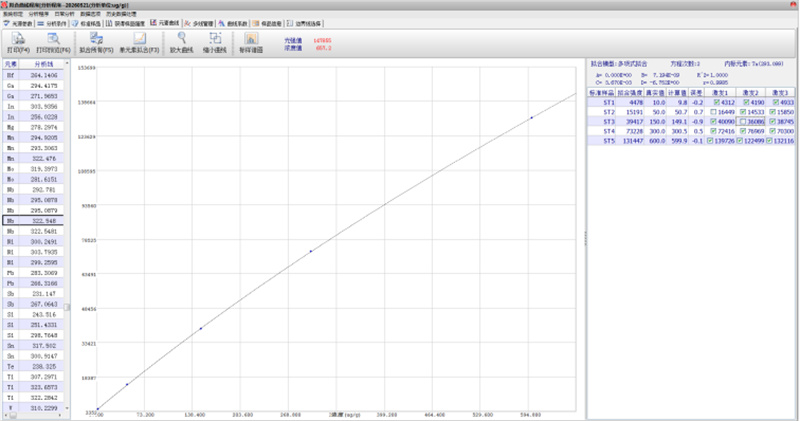
Figure 1: Niobium working curve
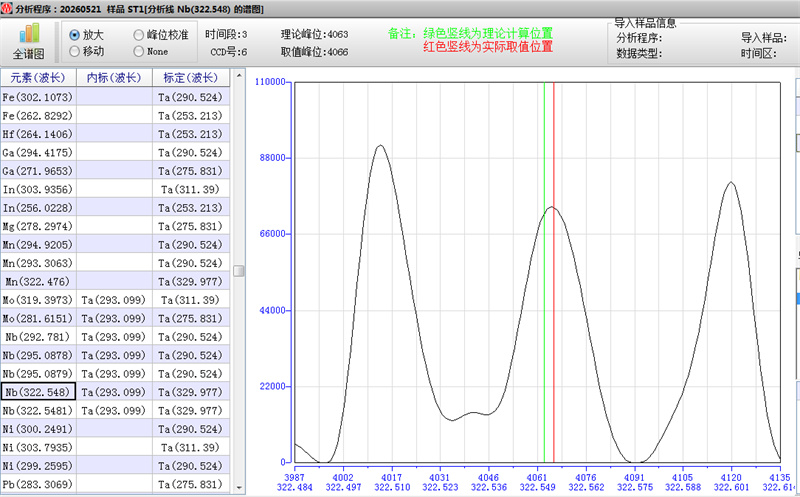
Figure 2 Niobium element 10 ppm content spectrum
3. Three Methods in One – Saving Time and Effort While Improving Efficiency
Through this method, three detection standards in the national standard methods for tantalum-niobium analysis can be completed in a single run—GB/T 15076.9 “Determination of Iron, Chromium, Nickel, Manganese, Titanium, Aluminum, Copper, Tin, Lead and Zirconium Content in Tantalum – DC Arc Atomic Emission Spectrometry,” GB/T 15076.2 “Determination of Niobium Content in Tantalum – Inductively Coupled Plasma Atomic Emission Spectrometry and Chromatographic Separation Gravimetric Method,” and GB/T 15076.6 “Determination of Silicon Content – Inductively Coupled Plasma Atomic Emission Spectrometry.”
The content that was originally detected stepwise by three different methods—arc atomic emission spectrometry (for iron, chromium, nickel, manganese, titanium, aluminum, copper, tin, lead, and zirconium in tantalum), acid dissolution (for niobium in tantalum) ICP-AES, and alkali dissolution (for silicon in tantalum) ICP-AES—has been integrated and optimized into a single detection method, and the indicators measured in one run fully meet the detection requirements.
Of course, in addition to the 12 elements specified in the above three national standards—Fe, Cr, Ni, Mn, Ti, Al, Cu, Sn, Pb, Zr, Ta, and Si—this method can also simultaneously determine more than 20 elements in total, including Ag, As, Ba, Bi, Ca, Cd, Co, Mg, Mo, Sb, and Y, significantly improving detection efficiency.
4. Summary
This method requires no complex sample pretreatment and directly measures powder samples. A single experiment can simultaneously determine more than 20 impurity elements without the need for stepwise detection, greatly shortening the detection cycle and improving quality inspection efficiency.
This method can be widely applied to factory quality inspection, incoming material sampling inspection, and scientific research and development testing of high-purity tantalum powder, tantalum wire, tantalum-based composite materials, and other products. It precisely controls raw material purity, optimizes production processes, avoids product performance defects caused by excessive impurities from the source, and provides reliable data support for high-end tantalum materials and high-end equipment supporting applications.
The RAYLEIGH AES-8000 Full-spectrum AC/DC Aarc Emission Spectrometer from Beifen-Ruili, under Jingyi Intelligent Technology, requires no complex sample pretreatment and directly measures powder samples. It features automatic calibration and background subtraction, delivering efficient and accurate detection. The AC/DC light source adapts to multiple types of samples, and a single experiment can simultaneously determine more than 20 impurity elements without the need for stepwise detection, greatly shortening the detection cycle and improving quality inspection efficiency.
When used in conjunction with this method, the AES-8000 instrument can be applied to factory quality inspection, incoming material sampling inspection, and scientific research and development testing of high-purity powders, molybdenum wire, molybdenum-based composite materials, and other products. It precisely controls raw material purity, optimizes production processes, avoids product performance defects caused by excessive impurities from the source, and provides reliable data support for high-end materials and high-end equipment supporting applications.
Post time: Oct-30-2026