

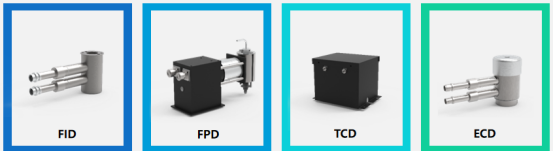
In the previous article, we introduced the two most common detectors in gas chromatography instruments — the FID flame ionization detector and the TCD thermal conductivity detector. These two are also the most versatile and busiest members of the gas chromatography detector family. They can be found in laboratories across industries such as petrochemicals and energy, environmental protection and monitoring, pharmaceuticals and food safety, semiconductors and industrial gases, and universities and scientific research.
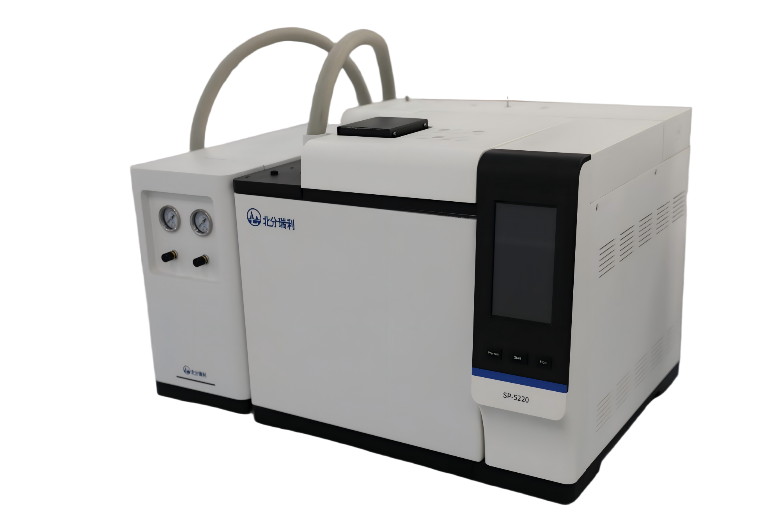
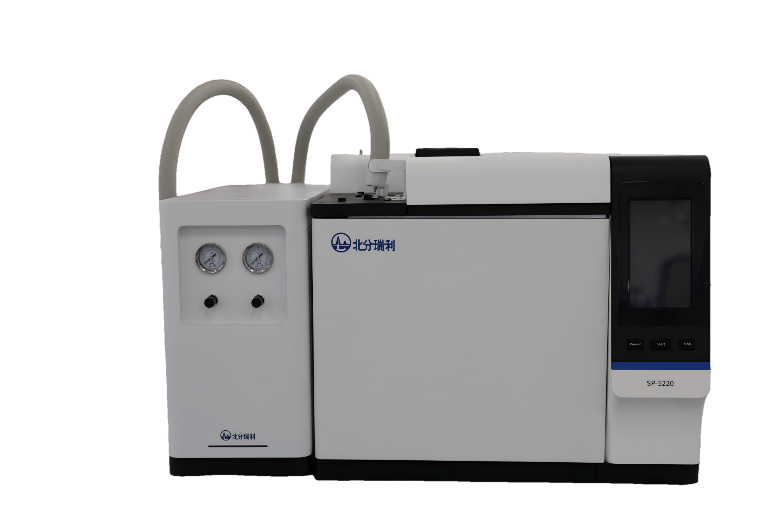
BFRL SP-5000 seriesGAS CHROMATOGRAPH
This time, we will continue by introducing two other gas chromatography detectors that are also widely used in the industry — the FPD flame photometric detector and the ECD electron capture detector. Their roles in fields related to people’s livelihoods, such as environmental protection, food and pharmaceuticals, and petrochemicals, are equally irreplaceable.
1) FPD — Detection of Sulfur and Phosphorus Compounds
Overview: The Flame Photometric Detector, abbreviated as FPD. FPD is typically used in gas chromatography as a detector dedicated to trace sulfur compounds and phosphorus compounds. Its principle is to detect the characteristic spectral signals of sulfur and phosphorus compounds in a hydrogen-rich flame.
FPD offers high sensitivity and good selectivity. Conventional FID/TCD detectors, however, suffer from problems such as poor peak shape and low accuracy when detecting trace sulfur and phosphorus compounds, hydrogen sulfide, carbonyl sulfide, mercaptans, thioethers, and similar substances.
Applications: Used for the analysis of hydrogen sulfide, carbonyl sulfide, methyl mercaptan, ethyl sulfide, and others in scenarios such as sulfur-containing gases, oil product desulfurization, odorous gases, chemical tail gas, and organophosphorus pesticide residues.
Features: Its advantage is extremely strong selectivity for sulfur and phosphorus, resistance to hydrocarbon interference, and effortless ppm/ppb-level detection. However, it should be noted that the response for sulfur measurement is non-linear, so curve calibration must be used; quantification cannot be performed after single-point calibration.
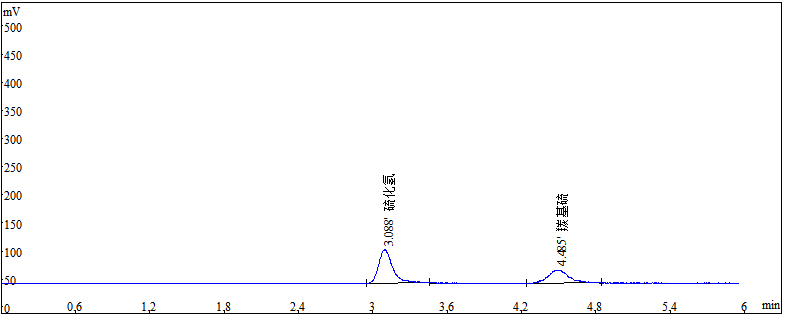
Case: Taking the configuration provided to a coal chemical company in Shanxi Province as an example, the user’s detection requirement was the accurate quantification of trace hydrogen sulfide and carbonyl sulfide. Using the SP-5110 gas chromatograph, equipped with a polytetrafluoro Porapak QS column and an FPD detector dedicated to sulfur and phosphorus, it provided highly sensitive responses to the target components. The detection time was less than 5 minutes. The chromatogram is shown below.
2) ECD — Detection of Halogens and Highly Toxic Trace Impurities
Overview: The Electron Capture Detector, abbreviated as ECD. ECD is one of the most sensitive detectors in gas chromatography. It uses electronegativity to capture electrons, and the decrease in the detector’s baseline current generates a signal. It is typically used for the detection of trace impurities, highly toxic substances, halogenated hydrocarbons, and others. It responds only to electronegative substances and is a dedicated trace-level detector.
Applications: Analysis of chlorinated hydrocarbons, Freon, pesticide residues, nitro compounds, trace oxygen impurities, and others. It is widely used in the detection of environmental pollutants in pesticide residues, water bodies, and soil. It is suitable for trace impurity analysis of high-purity gases, environmental testing, pesticide residue testing, specialty gas quality inspection, and more.
Features: ECD only produces peaks for strongly electronegative substances (it has almost no response to electrically neutral substances such as hydrocarbons), and its anti-interference performance is outstanding. Its detection limit can reach below \(10^{-13}g\), which is 2–3 orders of magnitude higher than FID. However, ECD’s linear range is usually relatively narrow, generally in the range of \(10^{2}\sim10^{4}\), and it is easily affected by carrier gas purity, moisture, oxygen, and other factors, leading to deterioration in signal stability and reproducibility.
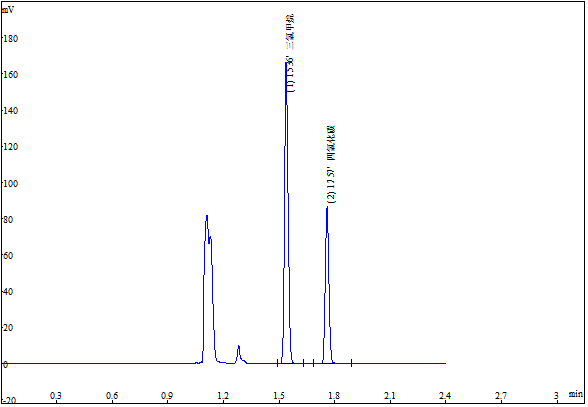
Case: Taking the configuration provided to a waterworks in Anhui Province as an example, the user’s detection requirement was the detection of halogenated compounds such as chloroform and carbon tetrachloride in the plant’s water. Using the SP-5110 gas chromatograph, equipped with a weakly polar BH-5 column and an electron capture detector (ECD), and using a split/splitless injector for sample introduction, accurate separation and quantification of the two trace impurity components were completed in only 2 minutes. The chromatogram is shown below.
At this point, we have introduced the four common detectors in gas chromatography instruments. With its strong separation capability, high analysis efficiency, and broad applicability, gas chromatography technology is widely used in many fields, including petrochemicals, environmental monitoring, food safety, and medical pharmaceuticals. Among them:
FID detector — high sensitivity, wide linearity, and strong stability for measuring hydrocarbons. It is widely used in the petrochemical and energy industries for the analysis of natural gas, refinery gas, and light hydrocarbon components in oil products.
TCD detector — although not highly sensitive, it has strong universality. It is widely used in the chemical and environmental protection industries for constant-level component analysis and permanent gas detection.
FPD detector — used for specialized determination of characteristic sulfur and phosphorus pollutants. It is widely used in environmental monitoring, food safety, and other industries to meet needs such as trace analysis of sulfides in exhaust gas and detection of phosphorus-containing pesticide residues.
ECD detector — outstanding analytical performance for halogenated and electronegative substances. It is widely used in hydrology, environmental protection, and other industries for the detection of trace pollutants such as halogenated hydrocarbons and organochlorine pesticides in water bodies and soil.
In one simple sentence: among the four major detectors, FID focuses on trace organic compounds, TCD focuses on constant-level components + inorganic substances, FPD focuses on sulfur and phosphorus compounds, and ECD focuses on halogen compounds. If you would like to know more relevant information, please contact the BFRL International Trade Department directly at international@bfl.com.cn. We look forward to communicating with you.
Post time: Sep-15-2026