

What is Simulated Distillation? Why is it “Difficult to Perform”?
In the analysis of various petroleum fraction products in the petrochemical industry, boiling range distribution is a key indicator for measuring product quality and guiding process control. While traditional distillation methods are intuitive, they suffer from long duration, high sample consumption, and poor repeatability, making them inadequate for modern industrial rapid detection needs.
Thus, simulated distillation emerged. China’s standard NB/SH/T 0558-2016 sets stringent requirements for these indicators: from high-temperature range rise and cold-point design to baseline drift ≤1% FS/h, each criterion tests the instrument’s true performance. How does the BFRL SP-5220 meet these specifications one by one with precision?
Method Principle
The simulated distillation method does not directly quantify by individual chromatographic peak area, but first establishes a “retention time–boiling point” correspondence, then slices and accumulates the sample chromatogram along the time axis. The cumulative flow percentage is converted to the corresponding temperature, thereby obtaining the boiling path distribution of the sample. Simply put, it uses chromatography to “simulate” the physical distillation process.
However, this method places extremely high demands on the instrument:
1.The calibration curve must be stable—any slight drift in the retention time–boiling point relationship will cause deviations in distillation point results.
2.The reference oil chromatogram must be continuous—any peak distortion, tailing, or abnormal response indicates a system fault.
3.Software algorithms must be standardized—slice integration, temperature conversion, and distillation point interpolation must all strictly follow the NB/SH/T 0558 standard.
Therefore, a truly qualified simulated distillation system must simultaneously meet standards in gas circuit control, temperature control, detector linearity, and software algorithms. The Beifen Ruilili SP-5220 is designed precisely for this purpose.
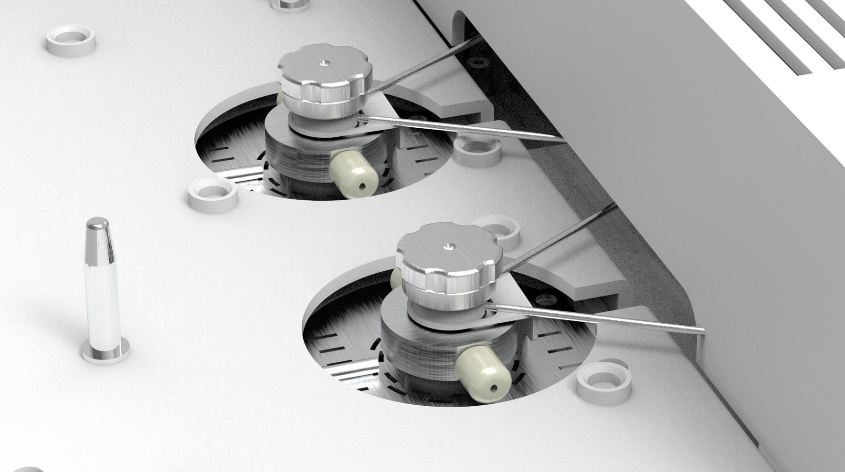
Detection Chromatograms and Results
1) Retention time-boiling point calibration relationship
As shown in the Figure 1 Retention time-boiling point calibration relationship, the retention time–boiling point curve established at the standard point of Ortho alkanes is continuous and has good monotonicity, serving as the basis for simulated distillation temperature conversion.
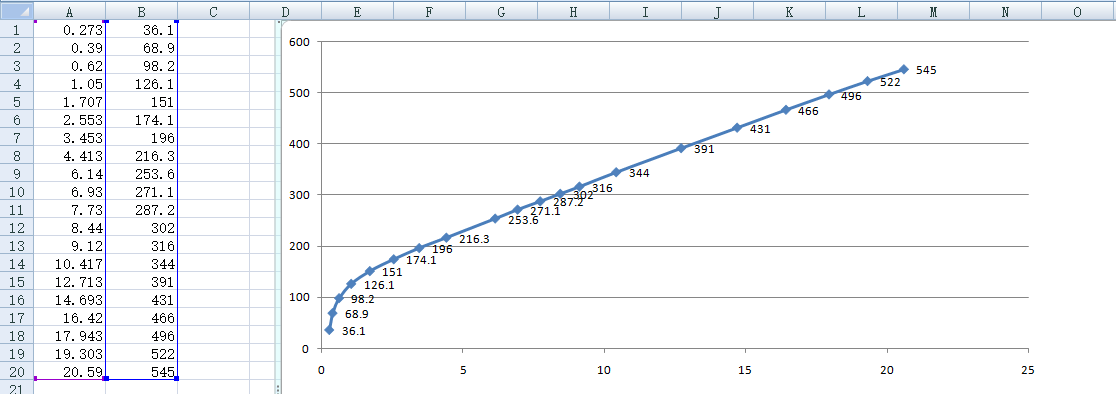
Figure 1 Retention time-boiling point calibration relationship
1) C5–C44 Standard Chromatogram
In the standard sample chromatogram, the elution order of each component is clear, and the peak distribution aligns with the calibration relationship, supporting subsequent sample boiling range conversion.
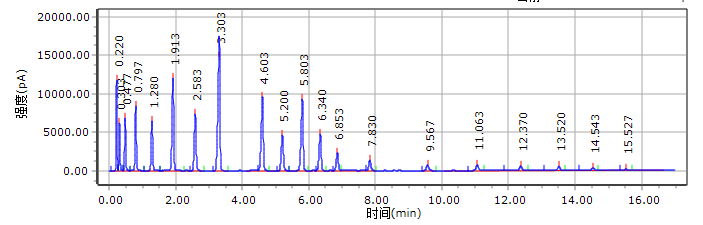
Figure 2 C5–C44 Standard Chromatogram
1) Reference Peak Correlation and Reference Oil Chromatogram
The reference peak correlation and reference oil chromatogram can be used to confirm the operational status of the method. The chromatogram shows that the reference peak position has an identifiable correlation with the sample distribution, and the reference oil exhibits a continuous distribution characteristic across the full boiling range.
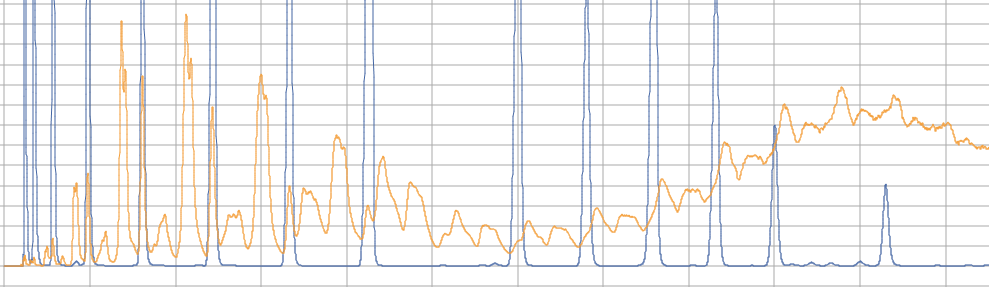
Figure 3 reference peak correlation
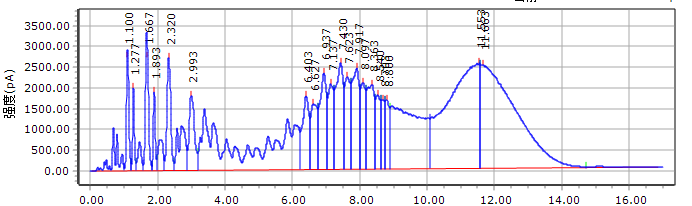
Figure 4 reference oil chromatogram
1) Summary of Reference Oil Results
Based on the original results page, the key distillation point data for reference oils is as follows. All measured values at each point are within the allowable range corresponding to the target value.
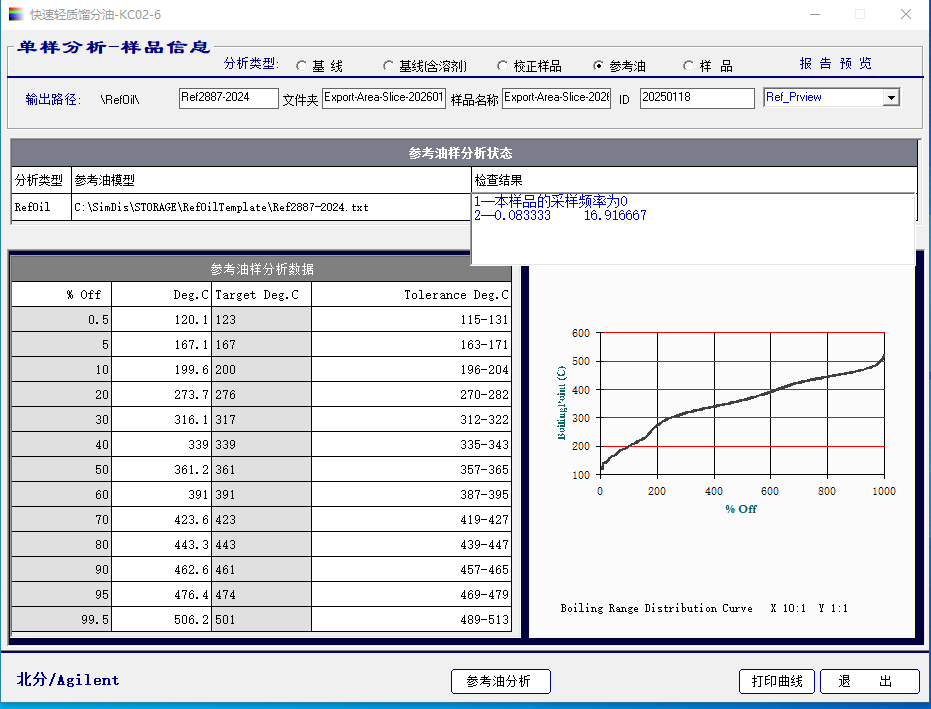
Figure 5 Software results page
| Distillation Point/% | Measured Temp./℃ | Target Temp./℃ | Allowable Range/℃ | Judgment |
|
0.5 |
120.1 |
123 |
115–131 |
Pass |
|
5 |
167.1 |
167 |
163–171 |
Pass |
|
10 |
199.6 |
200 |
196–204 |
Pass |
|
20 |
273.7 |
276 |
270–282 |
Pass |
|
30 |
316.1 |
317 |
312–322 |
Pass |
|
40 |
339.3 |
339 |
335–343 |
Pass |
|
50 |
361.2 |
361 |
357–365 |
Pass |
|
60 |
391.0 |
391 |
387–395 |
Pass |
|
70 |
423.6 |
423 |
419–427 |
Pass |
|
80 |
443.3 |
443 |
439–447 |
Pass |
|
90 |
462.6 |
461 |
457–465 |
Pass |
|
95 |
476.4 |
474 |
469–479 |
Pass |
|
99.5 |
506.2 |
501 |
489–513 |
Pass |
Test Conclusion
Combining the calibration curve, standard sample chromatogram, reference peak correlation, reference oil chromatogram, and reference oil result table confirms that the instrument’s test results cover the key evidence required for the normal operation of the simulated distillation method:
✔ The retention time–boiling point calibration curve is continuous, providing a basis for temperature conversion.
✔ The C5–C44 standard sample exhibits a clear elution order, supporting method calibration.
✔ The reference oil chromatogram distribution is normal, enabling signal acquisition across the entire boiling range.
✔ Key distillation point results for the reference oil all fall within the allowable range, with complete result output.
Under the NB/SH/T 0558-2016 standard method, the Beifen Ruili SP-5220 Gas Chromatograph provides efficient and reliable analytical support to users in the petrochemical field, backed by solid data and standardized methodological procedures.
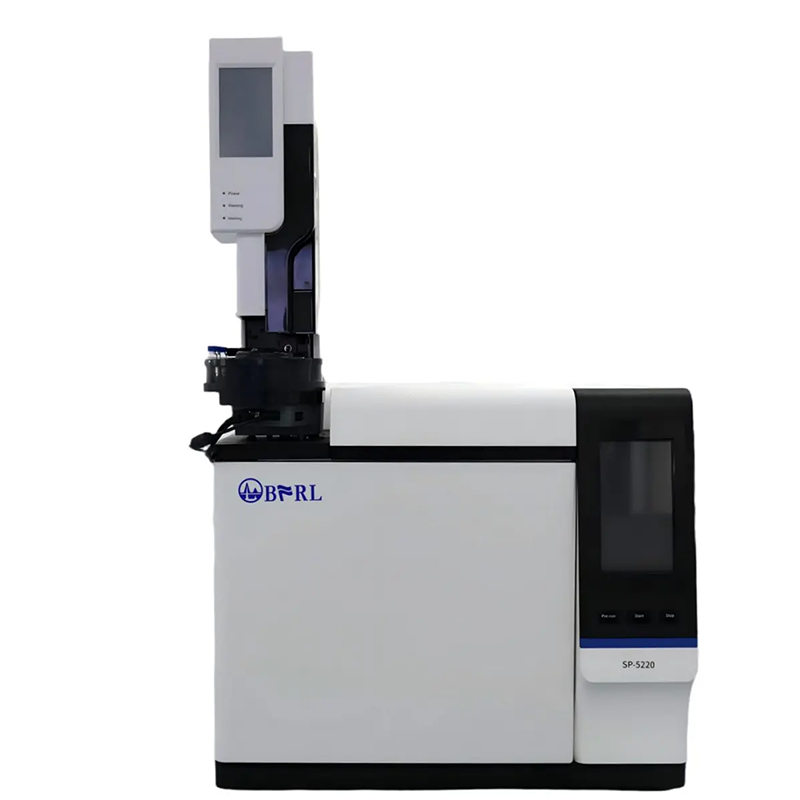
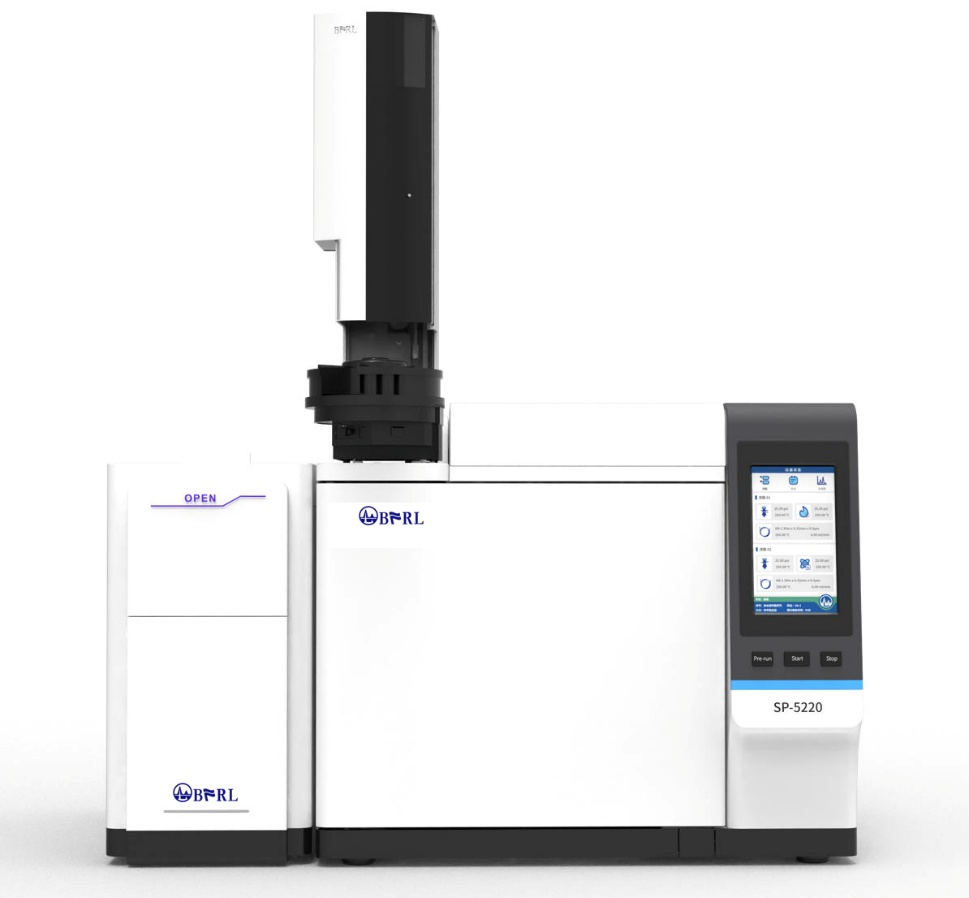
SP-5220 Gas Chromatograph equipped with the liquid autosampler
List of Instruments and Equipment Used
|
Model / Name / Parameters |
Type |
| SP-5220 Gas Chromatograph |
Instrument Host |
| BF-5008 Liquid Autosampler with19-bit sample tray |
External Device |
| BFRL-H300 Hydrogen generator |
External Device |
| BFRL-A3 Air generator |
External Device |
Post time: May-27-2026