

Cadmium is a highly toxic heavy metal found in soil and sediments, making its pollution control and precise monitoring critically important. To standardize detection methods and improve analytical performance, the Ministry of Ecology and Environment of China issued the standard HJ 1426-2025 Soil and Sediment – Determination of Cadmium – Solid Direct Sampling/Graphite Furnace Atomic Absorption Spectrophotometry on December 22, 2025, which will officially come into effect on July 1, 2026. This standard introduces, for the first time, a graphite furnace atomic absorption method using solid direct sampling. It eliminates the traditional wet digestion step, effectively avoids reagent contamination and sample loss, and offers advantages such as high efficiency, environmental friendliness, and high sensitivity. This provides a solid technical foundation for soil pollution prevention and ecological environmental supervision.
This article presents a graphite furnace method where both the calibration curve and samples are processed using solid direct sampling. This approach further saves the cost and preparation time associated with cadmium standard solutions and related reagents. Through optimization of experimental conditions and analytical procedures, satisfactory results were achieved, demonstrating reliable graphite furnace analysis with solid sampling and no standard solutions required.

2 Experiment
2.1 Sample Preparation
Soil samples were collected and preserved according to the relevant provisions of HJ/T166 and GB/T32722. Sediment samples were collected and preserved following the relevant requirements of HJ/T91, HJ/T494, GB17378.3, and HJ442.4.
Extraneous materials (e.g., twigs, leaves, stones) were removed from the samples. Soil and sediment samples were then prepared according to the specifications of HJ/T166 and GB17378.5, respectively. A portion of the soil sample was used for the determination of dry matter content, and another portion was used to prepare Sample 1. Similarly, a portion of the sediment sample was used for moisture content determination, and the remainder was used to prepare Sample 2. All samples were passed through a 200-mesh nylon sieve before storage.
After taring the sample boat, approximately 0.3–0.7 mg of the test sample (accurately weighed to 0.01 mg) was transferred into the boat. Immediately after weighing, 20 μL of matrix modifier (0.5 g/L palladium nitrate) was added to the sample boat, and the mixture was allowed to dry.
2.2 Instrumental Conditions
The analysis was performed using atomic absorption spectrometry. Recommended instrument parameters are listed in below.
Table 1. Reference conditions for graphite furnace method instruments
|
Element |
Wavelength (nm) |
Step temperature (° C), time (s) |
|||
|
Drying |
Ashing |
Atomization |
Cleaning |
||
|
Cd |
228.8 |
160,15 |
550,20 |
2200,3 |
2400,2 |
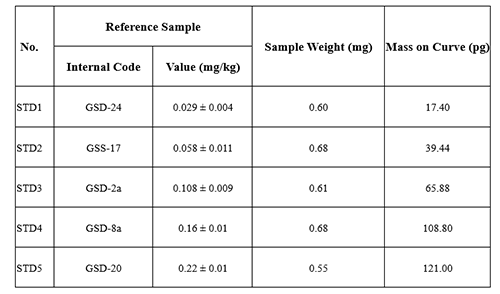
Calibration Curve Preparation: Approximately 0.5–0.7 mg of commercially available soil and sediment reference materials (GSD-24, GSS-17, GSD-2a, GSD-8a, GSD-20) were accurately weighed (to 0.01 mg) into graphite sample boats. 20 μL of matrix modifier (0.5 g/L palladium nitrate) was then added. The relative cadmium content was calculated based on the sample weight (the sample intake for the standard materials used in this test is shown in Table 2 below). The boats were horizontally introduced into the graphite tube, and the absorbance was measured to establish the calibration curve.
Table 2. Cd Mass Calibration Curve
3 Results and Discussion
Under the selected experimental conditions, good linearity for Cd was achieved in the range of 0–12 ng, with a correlation coefficient greater than 0.998. The calibration curve equation was: A = 0.004180c - 0.007813, as shown in Figure 2 below.
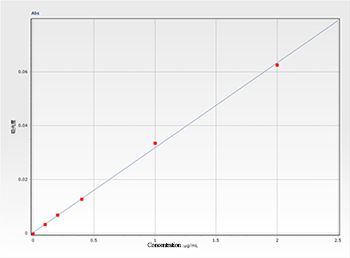
Figure 2: Calibration Curve for Cd
A blank standard sample was prepared and measured 11 times according to the procedure. The detection limit, calculated as three times the standard deviation of the blank divided by the slope of the calibration curve, was 0.77 pg for cadmium.
The prepared soil and sediment samples were analyzed under the selected conditions. After deducting the moisture content, the results are shown in Table 3 below.
|
Element |
Sample 1 |
Sample 2 |
|
Measured Value (mg/kg) |
Measured Value (mg/kg) |
|
|
Cd |
0.15 |
0.17 |
The certified reference materials GSS-9 and GSS-14 (soil composition) were measured seven consecutive times. The results are presented in Table 4 below.
|
Element |
Reference Sample No. |
Certified Value (mg/kg) |
Measured Value (mg/kg) |
Accuracy |
RSD for 7 Replicate |
|
Cd |
GSS-9 |
0.1 ± 0.02 |
0.092 |
92.0% |
11.25% |
|
GSS-14 |
0.2 ± 0.02 |
0.194 |
97.0% |
10.18% |
As shown in Tables 3 and 4, the relative standard deviations (RSDs) for the 7 replicate measurements of the certified reference materials ranged from 10.18% to 11.25%. The measured values for the reference materials were within the acceptable range of the certified values, demonstrating good precision and accuracy of this test.
4 Conclusion
In this study, the WFX-220C Atomic Absorption Spectrophotometer (manufactured by Beifen-Ruili, a subsidiary of BIIC), equipped with a solid direct sampling accessory for the graphite furnace, was used. Following the HJ 1426-2025 standard, the complete solid direct sampling method was successfully applied for the determination of cadmium in both calibration standards and actual samples. The achieved detection limits, accuracy, and precision were satisfactory.
The use of the full solid sampling mode offers significant advantages for cadmium determination:
Eliminates complicated digestion: Weigh and measure directly, greatly enhancing analytical efficiency.
Green and safe: Eliminates the need for strong acids throughout the process, removes the risk of reagent blank contamination, ensures operator safety, and produces zero acid waste discharge.
Improved accuracy: Prevents elemental loss or adsorption that can occur during digestion, truly reflecting the sample background for more reliable and accurate data.
Post time: Jun-27-2026